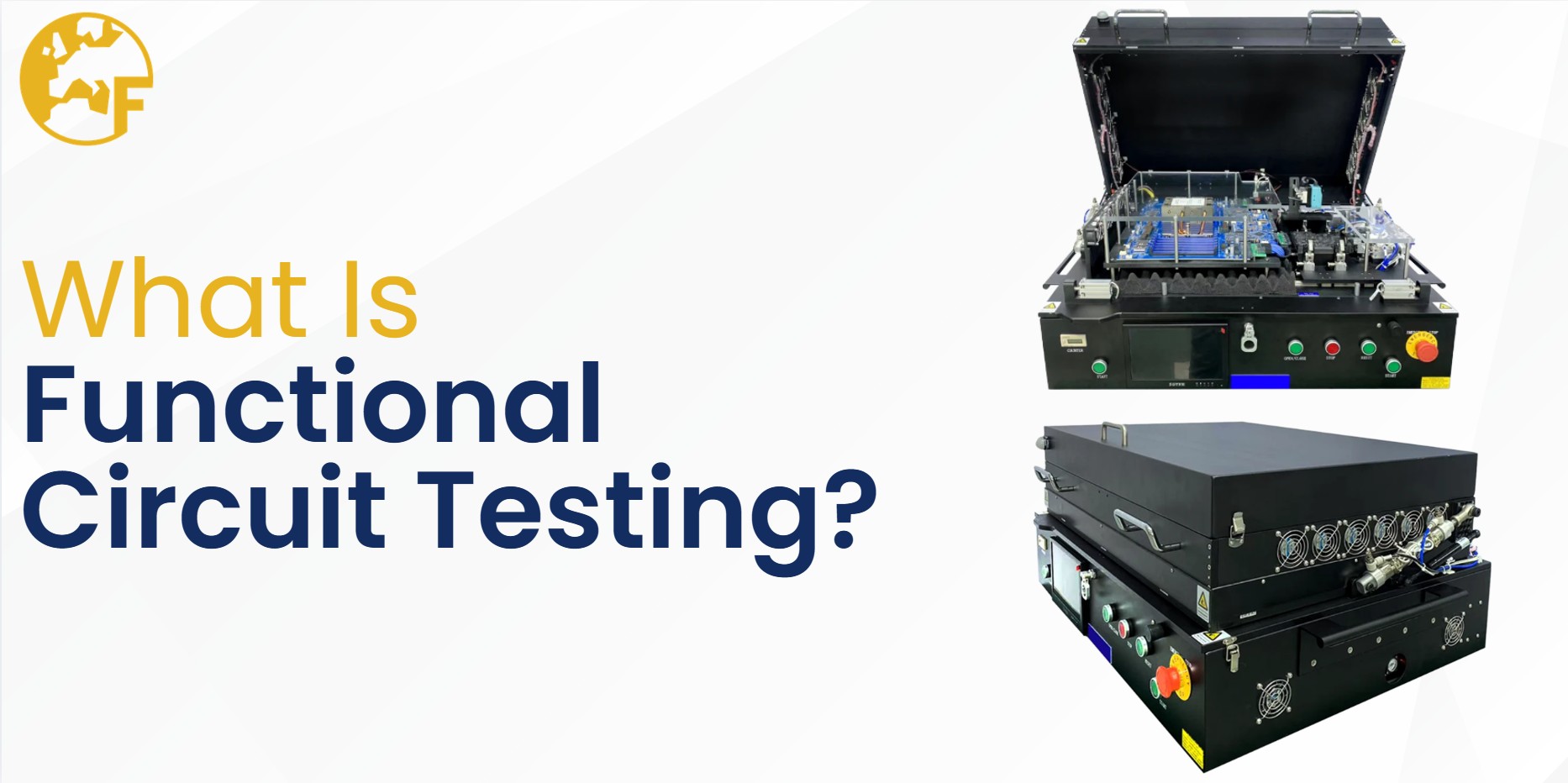
What Is Functional Circuit Testing (FCT)?
Functional Circuit Testing (FCT) is the process of verifying a fully assembled PCBA by applying real operating power and checking that every intended function performs correctly. Rather than examining individual components in isolation, FCT treats the board as a complete system, exercising its inputs, outputs, firmware, and communication interfaces as it will actually be used in the field.
Unlike a visual inspection or a component-level electrical check, FCT provides system-level verification. It confirms that the board has the right parts in the right places, and that those parts work together correctly under load.
Learn more about our full range of Functional Test Fixture services and products.
Contents
What Is Functional Circuit Testing (FCT)?
Why does FCT exist?
How Does Functional Circuit Testing Work?
Types of FCT.
What Common Faults Are Detected by FCT?
Advantages of Functional Circuit Testing
When Should You Use FCT?
Where Is FCT Commonly Used?
FCT vs. In-Circuit Testing (ICT)
Forwessun’s FCT Solutions and Services
Frequent Questions About Functional Circuit Testing
Why does FCT exist?
Modern PCBAs are more complex than ever. They contain microcontrollers, communication interfaces, power‑management ICs, sensors, RF modules, and firmware that all have to work together seamlessly. Even if every component is correctly placed and soldered, the board can still fail when powered up, and these failures often only appear under real operating conditions.
This is the gap that Functional Circuit Testing (FCT) is designed to close.
ICT can confirm that a board is correctly built, but it cannot confirm that the board actually works. ICT checks for shorts, opens, wrong values, missing components, and solder defects, but it does not validate firmware behaviour, timing, communication protocols, RF performance, or power‑on functionality.
As electronics have become more integrated and software‑driven, these functional issues have become some of the most common causes of field failures.
FCT exists because manufacturers need to answer a different question:
“Does this board perform its intended function when powered up, under real operating conditions?”
Functional Circuit Testing provides that answer by applying real power, stimulating inputs, measuring outputs, exercising communication interfaces, and validating firmware. It ensures the board behaves exactly as designed before it moves into final assembly or reaches the customer.
How does Functional Circuit Testing (FCT) Work?
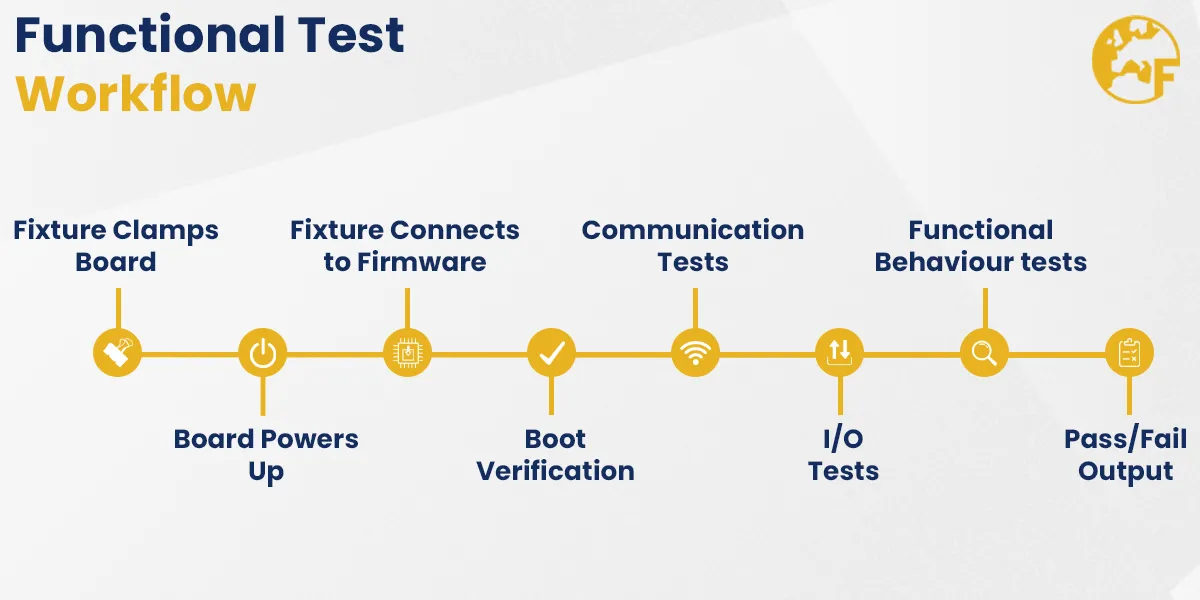
A functional test fixture makes contact with a board’s connectors, headers, or designated test points, with each fixture custom-built around the specific product it’s designed to test. The functional test system then powers the board up, applies a defined sequence of input signals, and captures the outputs for comparison against expected results.
Depending on the product, this can involve digital I/O testing, analogue signal analysis, button / switch actuation, communication interface checks (such as USB, CAN, or Ethernet), RF performance verification, or firmware programming and validation.
Every function the board is designed to perform can be tested and measured. Results are logged automatically, giving manufacturers full traceability on every unit that passes through the line.
FCT is typically run after In-Circuit Testing (ICT), once component-level integrity has already been confirmed. Together, the two methods cover both how the board was built and how it performs in real-world conditions.
Want a bespoke functional test fixture? See how Forwessun designs FCT fixtures for even the most complex boards and assemblies.
Types of FCT
Functional testing exists at two distinct stages of manufacturing: PCBA‑level and product‑level/full assembly. Although both aim to confirm correct operation, they serve different purposes, use different equipment, and answer different engineering questions. Understanding the distinction is essential when planning a complete test strategy.
Board‑Level Functional Testing (FCT)
Board‑level FCT is performed on the bare PCBA, before it is installed into a housing or connected to mechanical assemblies. The goal is to verify that the electronics behave correctly under real operating conditions.
Board‑level FCT checks:
- Power‑on behaviour and voltage rails
- Digital and analogue signal performance
- Communication interfaces (USB, CAN, Ethernet, RS‑232, etc.)
- Firmware programming and validation
- RF and wireless performance
- Timing‑sensitive behaviour
- Sensor and interface electronics (electrical response, not mechanical action)
This stage ensures the board is electrically sound, firmware‑stable, and functionally correct before it becomes part of a larger product. It is the final confirmation that the PCBA works as designed.
Product‑Level Functional Testing (FT/EOL)
Product‑level functional testing, often called a Functional Test (FT) or End‑of‑Line (EOL) testing, is performed after the PCBA has been installed into its enclosure, connected to mechanical parts, and assembled into a complete product.
Product‑level FT checks:
- Mechanical behaviour (motors, fans, valves, pumps)
- User interface operation (buttons, displays, touch panels)
- Full system communication
- Safety interlocks
- Environmental behaviour (thermal, vibration, load)
- Application‑level functionality
- Final firmware behaviour in the complete product
- Product‑specific workflows or modes
This stage ensures the final assembled device behaves correctly as a complete system, not just as an electronic board.
What are Common Faults Detected by FCT Testing?
FCT is designed to catch the faults that component-level testing simply isn’t built to see, including:
- Firmware or software failures
- Incorrect signal timing or communication errors
- Power delivery and regulation faults
- Sensor, actuator, or interface malfunctions
- Design marginalities that only appear under real operating load
- Faults introduced downstream of the board itself, such as connector or cable issues
These are exactly the kinds of problems that can elude ICT testing, since every component may be correctly placed and soldered, and still cause the finished product to fail in the customer’s hands. That’s why FCT is such an important step in component-level testing, especially in safety-critical industries such as medical, automotive, and aerospace.
Advantages of Functional Circuit Testing:
FCT offers several significant advantages:
- Real-world verification: Testing under actual operating conditions catches faults that component-level checks can’t see.
- System-level confidence: Confirms the board performs every intended function, not just that it’s correctly assembled.
- Comprehensive data logging: Every test run is recorded, supporting traceability and long-term quality improvement.
- Reduced field failures: Catching functional faults on the bench avoids costly returns, rework, and warranty claims further down the line.
- Complements component-level testing: Used alongside ICT, FCT closes the gap between “correctly built” and “correctly working”.
When Should You Use FCT Testing?
FCT is the go-to method when:
- You need to confirm a board performs its intended function, not just that it’s correctly assembled
- The product includes firmware, communication interfaces, or RF functions that only reveal faults under real operation
- You’re shipping into safety-critical or highly regulated sectors such as medical, automotive, industrial, or aerospace
- You want end-to-end traceability on every unit before it leaves the factory
It’s most effective when used alongside in-circuit testing, giving you both component-level accuracy and full functional confidence.
Where Is FCT Commonly Used?
Functional Circuit Testing is used wherever a product’s real-world performance matters as much as its build quality. Because FCT verifies actual operating behaviour rather than just assembly accuracy, it’s become a standard final checkpoint across industries where a failure in the field carries serious cost or safety consequences.
Automotive Electronics
ECUs, sensor modules, and communication units all need to perform correctly under real driving conditions. FCT verifies that these safety-critical modules behave exactly as designed before they’re integrated into a vehicle rollout.
Medical Devices
Medical electronics can’t afford functional ambiguity. FCT confirms that diagnostic equipment, monitoring systems, and handheld instruments perform intended functions correctly.
Aerospace & Defence
In aerospace and defence, every function has to work exactly as intended, every time. FCT provides the operational verification needed to validate mission-critical systems against strict performance and safety requirements.
Industrial & Automation Systems
PLCs, motor controllers, and sensor modules often run continuously in demanding environments. FCT confirms these boards will actually perform under load before they’re deployed, reducing costly downtime later.
Telecommunications & Networking
Routers, switches, and communication modules depend on correctly functioning interfaces and signal paths. FCT verifies these functions directly, ensuring reliable performance in data centre and telecom infrastructure.
Consumer Electronics
Wearables, home automation devices, and entertainment systems benefit from FCT’s ability to confirm real-world functionality, including firmware and wireless performance, before products reach customers.
FCT vs. In-Circuit Testing (ICT)
Functional Circuit Testing (FCT) and In-Circuit Testing (ICT) are often used together, but they answer different questions. ICT checks that a board’s individual components were assembled correctly, no shorts, opens, or wrong values, while FCT confirms the finished board actually performs its intended functions under real operating power.
The table breaks down how the two methods compare on fixtures, speed, ideal use case, fault coverage, and cost.
| Feature | In-Circuit Testing (ICT Test) | Functional Testing (FCT) |
|---|---|---|
| Fixture Required | Yes | Sometimes |
| Speed | Fast (1-2 mins/board) | Varies |
| Best For | High-volume production | Final-stage validation |
| Fault Coverage | High – component-level | End-to-end testing |
| Cost | Higher upfront, lower per test | Varies |

Partner with Forwessun for Functional Test Solutions
At Forwessun, we provide a wide range of services, support, and products to the Automated Test Equipment industry. We support a range of high-profile industries across the globe, working across Computer Networking, Medical, Military and Aerospace, Automotive, Industrial, and more.
We design and manufacture Functional Test Fixtures, focusing on precision, accuracy, and production efficiency. Whether you’re testing complex boards or high-volume assemblies, our engineering team ensures your fixtures will meet the most demanding quality standards.
We also offer an extensive range of services, including fixture repair, calibration, and system upgrades, supporting businesses across various industries worldwide.
Get in touch today to learn more about our FCT solutions, request a quote, or explore how our tailored fixtures can improve your testing process.
Frequently Asked Questions About Functional Circuit Testing:
1) How does Functional Circuit Testing provide thorough testing?
FCT ensures thorough testing by exercising the board’s full range of intended functions under real operating conditions, rather than checking components in isolation. This confirms the board works as a complete system, not just that its parts are individually sound.
2) Can Functional Circuit Testing improve production efficiency?
Yes. FCT catches system-level faults before a board reaches final assembly or the customer, reducing costly downstream rework, returns, and warranty claims. Automated FCT sequences also keep test times short enough to fit into high-volume production lines.
3) What kind of data does Functional Circuit Testing provide?
FCT provides detailed pass/fail data on every function tested, along with logged signal measurements and operational parameters. This data supports traceability, helps identify recurring design or process issues, and feeds continuous improvement in manufacturing.
4) What is the difference between Functional Circuit Testing and In-Circuit Testing?
Functional Circuit Testing (FCT) verifies that an assembled board works as intended by simulating real-world operating conditions.
In-Circuit Testing (ICT) checks individual components on a PCB for manufacturing faults such as shorts, opens, and incorrect values. FCT focuses on overall functionality, while ICT focuses on component-level accuracy.
5) What is an FCT Fixture?
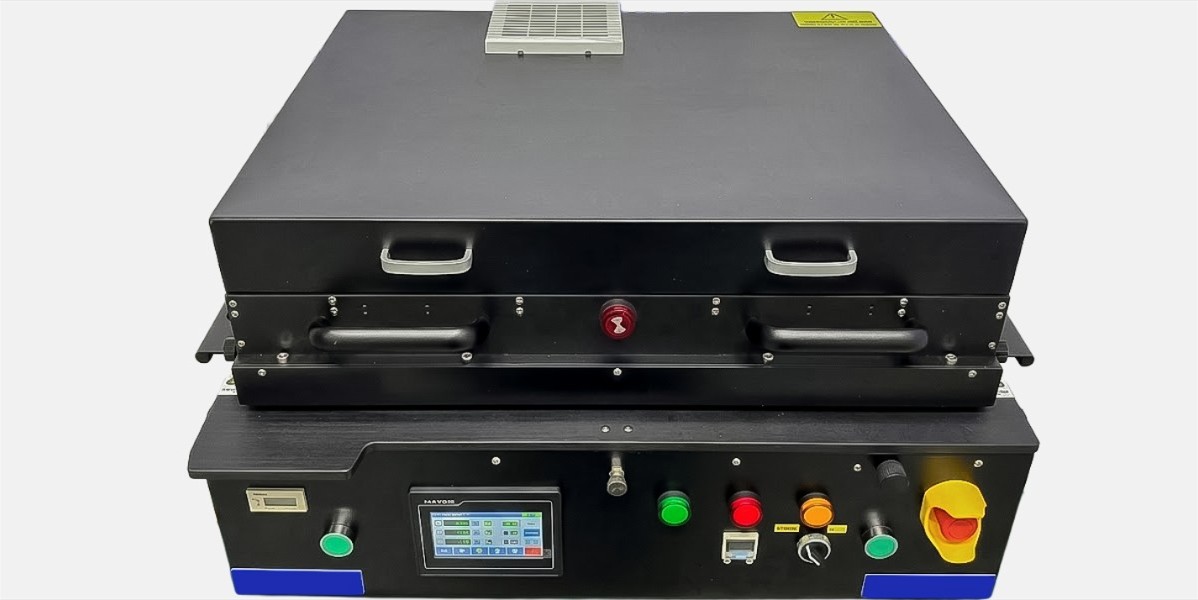
A functional test fixture is a custom-built test system designed to apply operational power to a PCBA and verify that it functions as intended. It interfaces with a board’s connectors, headers, or test points, allowing automated equipment to confirm every intended function.
6) What is the purpose of FCT testing?
The purpose of FCT is to confirm that a fully assembled board performs correctly under real operating conditions before it reaches final assembly or the customer. It catches system-level faults, firmware issues, and design marginalities that component-level testing can’t detect.
7) What does an FCT tester check?
An FCT tester checks the operational behaviour of a fully assembled board, including digital and analogue signal performance, communication interfaces, power delivery, firmware, and any RF or wireless functions. It applies real-world conditions and compares the resulting outputs against expected specifications.