In-Circuit Testing (ICT) – What is it and how does it work?
In-circuit testing (ICT), also referred to as a PCB ICT test or PCB in-circuit test, is the standard automated method for verifying that every component on a printed circuit board is in the right place, properly soldered, and electrically sound.
The process uses a custom bed-of-nails fixture connected to an in-circuit test system.
An ICT test applies precise electrical signals to each component in turn, checking resistance, capacitance, orientation and connectivity in a matter of seconds. If something is wrong, it gets flagged before the board goes any further down the line.
The upfront investment in fixturing and test programming is real, but it pays back quickly.
Catching a fault at the ICT stage costs a fraction of what it costs to find it after final assembly or in the field. For mid- to high-volume PCB production, in-circuit test is one of the most cost-effective quality tools available.
Forwessun designs and supplies custom in-circuit test fixtures, systems and software support across a wide range of industries, with engineers available worldwide. 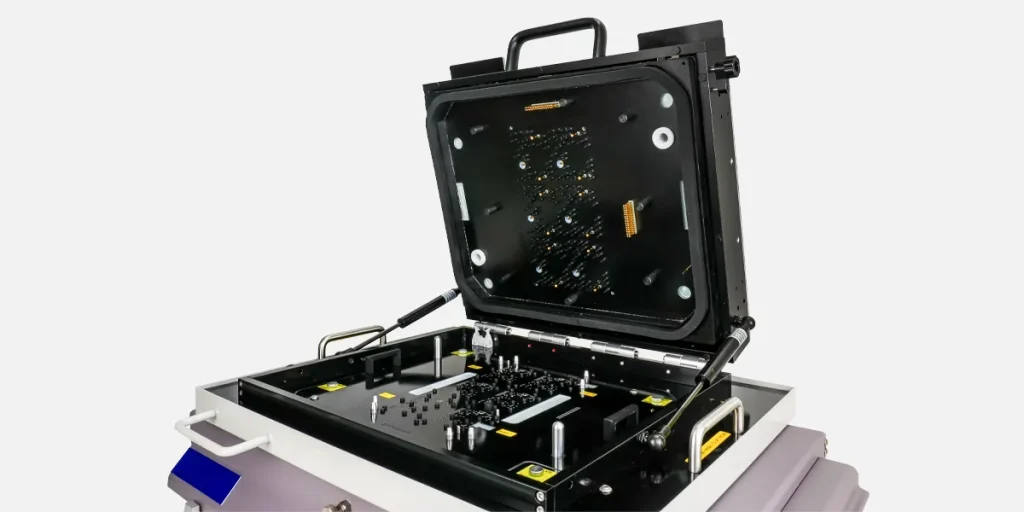
Contents
- What Is In-Circuit Testing (ICT)?
- How does In-Circuit Testing Work?
- What Is an In-Circuit Test System?
- What Common Faults are Detected by ICT?
- Key Questions About In-Circuit Testing
- Advantages of In-Circuit Testing
- ICT vs Flying Probe vs Functional Testing
- When Should You Use ICT?
- Where is ICT commonly used?
- Forwessun’s ICT Solutions and Services
What is In-Circuit Testing (ICT)?
In-Circuit Testing (ICT) is a precise and automated technique used to verify the performance and integrity of components mounted on a printed circuit board (PCB). Often referred to as “bed-of-nails testing”, this method uses spring-loaded probes to make contact with predefined test points on a PCB to identify electrical faults and manufacturing defects.
Unlike visual inspection or basic continuity checks, ICT test provides component-level analysis, ensuring each resistor, capacitor, diode, integrated circuit, or connector is both correctly placed and fully functional. Learn more about our full range of In-Circuit Test Fixtures and other ICT solutions. – In-Circuit Test (ICT) services and products. 
How does In-Circuit Testing (ICT) Work?
Custom test fixtures contain hundreds of probes precisely aligned with a PCB’s test points, with each fixture uniquely designed for a specific board layout. The system’s test software manages the fixture, applies test signals, evaluates results, and determines pass/fail status according to predefined limits.
During testing, the board is energised to simulate normal operating conditions, and each component is analysed individually to confirm it meets expected specifications for resistance, capacitance, orientation, and more. All test results are recorded for quality tracking and traceability.  ICT is fast, repeatable, and ideal for production environments that require high-volume, low-error output.
You can learn more about fixture and test probe maintenance by checking out our dedicated blog. Or if you need a bespoke test fixture? See how Forwessun designs high-accuracy ICT fixtures for even the most complex board layouts.
What Is an In-Circuit Test System?
An in-circuit test system, sometimes called an ICT tester, is the machine that drives the whole PCB ICT test process. The fixture is the board-specific tooling that makes physical contact with the PCB, but the in-circuit test system is what controls it. It generates the test signals, reads the measurements coming back, runs the test program, and decides whether each component passes or fails.
In-circuit test systems are reusable across many different products and fixture types, making them a long-term capital asset for any electronics manufacturer running mid- to high-volume production. Because the system stays the same while fixtures change with each new board design, manufacturers who standardise on one platform (an HP 3070, for example) can bring new products into test by commissioning a new fixture rather than replacing the system itself.
The system is the constant; the fixture is what gets designed around each PCB. When kept in good condition, the systems can also bring in value if resold on the second hand market. Refurbished Systems are a lower cost entry point into ICT testing. 
Common in-circuit test systems
The three dominant platforms in use today are
- HP/Agilent/Keysight 3070 – the most widely deployed in-circuit test system globally, known for its reliability, broad fixture compatibility, and extensive test library. Forwessun designs and manufactures HP 3070 ICT fixtures and provides HP 3070 systems support and refurbishment.
- Teradyne TestStation – a high-performance ICT tester used extensively in automotive, aerospace, and defence electronics manufacturing, valued for its speed and diagnostic depth. Forwessun supports Teradyne in-circuit test systems and builds compatible fixtures.
- GenRad 228x series – a trusted platform for complex, high-node-count boards, commonly found in industrial and telecommunications production. Forwessun supplies and supports GenRad test systems.
What are the Common Faults Detected by ICT Testing?
ICT testing excels at identifying early-stage defects, including:
- Incorrect component values or orientation
- Missing or misplaced parts
- Solder bridges or cold joints
- Open or short circuits
- Damaged components
- Faulty connectors
These faults, if left unchecked, can result in full product failures, especially in safety-critical industries such as medical, automotive, and aerospace.
Frequently Asked Questions About In-Circuit Testing:
1) How does In Circuit Testing provide thorough testing?
ICT ensures comprehensive testing by examining each component on the PCB. This process verifies that every part is functioning correctly, helping maintain the overall quality and reliability of the product.
2) Can In Circuit Testing improve production efficiency?
Absolutely! ICT is a fast and automated testing process that fits well into large-scale production environments. It quickly tests multiple PCBs, ensuring that the manufacturing process is not slowed down while maintaining high quality.
3) What kind of data does In Circuit Testing provide?
ICT provides accurate and reliable test data about the health of each PCB. This data helps manufacturers improve their quality control processes by pinpointing issues early on, leading to greater consistency in product quality.
4) What is the difference between In Circuit Testing and Functional Circuit Testing?
In-Circuit Testing (ICT) checks individual components on a PCB for manufacturing faults such as shorts, opens, and incorrect values. Functional Circuit Testing (FCT) verifies that the assembled board works as intended by simulating real-world operating conditions. ICT focuses on component-level accuracy, while FCT confirms overall functionality.
5) What is an ICT Fixture?
An ICT fixture is a custom mechanical setup that holds a printed circuit board in place during testing. It uses spring-loaded test probes to make electrical contact with specific points on the board, allowing automated equipment to measure and validate each component.
6) What is the purpose of ICT testing?
The purpose of ICT testing is to quickly identify manufacturing defects in a circuit board before it reaches final assembly or customers. It ensures components are correctly placed, soldered, and functioning, improving product quality and reducing costly rework later in production.
7) What is an in-circuit test system?
An in-circuit test system is the automated test platform that powers ICT, it controls the test fixture, applies electrical stimulus signals, interprets results, and logs pass/fail outcomes for every component. Common in-circuit test systems include the HP/Agilent 3070, Teradyne TestStation, and GenRad 228x series. Forwessun supplies, repairs, calibrates, and supports all major in-circuit test system families.
8) What does an ICT tester check?
An ICT tester checks individual components on a PCB for correct value, orientation, placement, and connectivity. This includes resistors, capacitors, diodes, transistors, integrated circuits, and connectors. The tester applies a signal, measures the response, and compares it to the expected specification, flagging any component that falls outside tolerance.
9) What is the difference between an ICT system and an ICT fixture?
An in-circuit test system is the machine, the hardware and software platform (such as an HP 3070 or Teradyne TestStation) that runs the test program. An ICT fixture is the custom board-specific tooling that connects the PCB’s test points to the system’s measurement channels. The system is reusable across many products; the fixture is unique to each PCB design.
Advantages of In Circuit Testing:
ICT offers several significant advantages:
- Speed and efficiency: Tests are completed within minutes, making ICT ideal for high-volume production environments.
- Consistent results: The automated nature of ICT ensures reliable and repeatable testing outcomes.
- Comprehensive coverage: Each component on the board receives individual attention, ensuring thorough quality control.
- Valuable data collection: Testing results provide insights that can help improve manufacturing processes.
- Cost-effective quality assurance: Although it requires initial investment, ICT significantly reduces costly rework and warranty claims. Read our dedicated blog and discover how you can Unleash Your Testing Potential with Forwessun’s Custom Fixtures.


In Circuit Testing vs Flying Probe vs Functional Testing Comparison
There are several advantages of ICT testing compared to other methods, such as the flying probe. One of the key factors is cost. You can see some of the key comparisons below.
| Feature | In-Circuit Testing (ICT Test) | Flying Probe Testing | Functional Testing |
|---|---|---|---|
| Fixture Required | Yes | No | Sometimes |
| Speed | Fast (1–2 mins/board) | Slower | Varies |
| Best For | High-volume production | Prototypes & small runs | Final-stage validation |
| Fault Coverage | High – component-level | Moderate | End-to-end testing |
| Cost | Higher upfront, lower per test | Low upfront, higher per test | Varies |
In Circuit Testing vs Flying Probe Price Comparison
Take a look at the graphic below to see a comparison between the cost per unit, the test time, long-term value, and more. You can read more about ICT V Flying probe in our dedicated blog, ICT vs Flying Probe. 
When Should You Use ICT Testing?
ICT is the go-to method when:
- You’re producing mid- to high-volume PCBs
- Fault prevention is mission-critical
- You require detailed diagnostics and traceability
- You’re working in regulated sectors like medical, military, or industrial electronics
It is often used in tandem with functional testing to cover both component integrity and overall device functionality.
Where Is ICT Commonly Used?
In‑Circuit Testing is widely used across industries where reliability, traceability, and consistent product quality are essential. Because ICT provides fast, repeatable, component‑level diagnostics, it has become the preferred method for mid‑ to high‑volume PCB production in sectors where even minor defects can lead to costly failures.
Automotive Electronics
Modern vehicles rely on dozens of safety‑critical electronic control units (ECUs), sensors, and communication modules. ICT ensures every component on these assemblies is correctly placed, soldered, and functioning before the unit reaches final assembly. With strict quality and compliance requirements, automotive manufacturers depend on ICT for its speed, accuracy, and repeatability.
Medical Devices
Medical electronics demand extremely high reliability and full traceability. ICT helps manufacturers detect early‑stage faults that could compromise patient safety, making it a key part of the validation process for devices such as diagnostic equipment, monitoring systems, and handheld medical instruments.
Aerospace & Defence
In aerospace and defence applications, failure is not an option. ICT provides the deep coverage and detailed diagnostics required to validate mission‑critical electronics, ensuring every component meets strict performance and safety standards.
Industrial & Automation Systems
Industrial control boards, PLCs, motor controllers, and sensor modules often run continuously in harsh environments. ICT helps manufacturers maintain high production yields and reduce downtime by catching defects early in the build process.
Telecommunications & Networking
Routers, switches, base stations, and communication modules contain dense, high‑node‑count PCBs. ICT’s ability to test thousands of points quickly makes it ideal for ensuring the reliability of networking hardware used in data centres and telecom infrastructure.
Consumer Electronics
High‑volume products such as wearables, home automation devices, and entertainment systems benefit from ICT’s fast cycle times and low per‑unit cost. Manufacturers use ICT to maintain consistent quality while keeping production costs under control.
Partner with Forwessun for In-Circuit Test Solutions
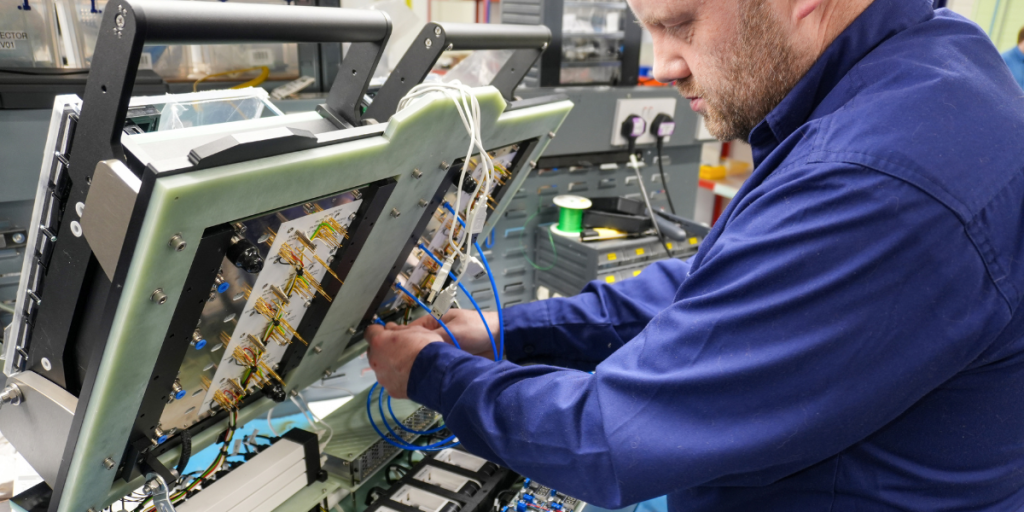 At Forwessun, we provide a wide range of services, support, and products to the Automated Test Equipment Industry. We support a range of world-class companies across the globe, working in a range of different fields and industries, including Computer Networking, Medical, Military and Aerospace, Automotive, Industrial, and more.
We provide In-Circuit Test fixtures that are designed to the highest level, focusing on precision and efficiency in the testing process. Whether you’re testing high-volume assemblies or handling specialised components, our expert team ensures that your fixtures meet the most stringent quality standards.
We also offer an extensive range of services, including fixture repair, calibration and system upgrades, supporting businesses across various industries worldwide.
Get in touch today to learn more about our ICT solutions, request a quote, or explore how our tailored fixtures can improve your testing process.
Key Takeaways
In-circuit testing checks components one by one, not just whether a board powers on. A bed-of-nails fixture makes contact at hundreds of predefined points, and the test system runs each resistor, capacitor, diode, and IC against its expected spec, catching wrong values, bad orientation, cold solder joints, and open or short circuits before the board moves further down the line.
The fixture and the system aren’t the same thing, and mixing them up costs money down the line. The system (an HP 3070, a Teradyne TestStation, a GenRad 228x) is the reusable capital equipment; the fixture is built fresh for each board layout.
Cost math favours ICT once volume is real. Tooling and programming aren’t cheap upfront. But a fault caught at the ICT stage costs far less to fix than the same fault found after final assembly, or worse, in the field. Flying probe wins for prototypes and short runs; ICT wins once you’re producing at mid-to-high volume.
It’s the default in industries where a missed defect isn’t just expensive but dangerous. Automotive, medical devices, aerospace, and defence electronics lean on ICT because component-level traceability matters when the part in question ends up in a car’s ECU or a diagnostic device.
ICT and functional testing answer different questions. ICT confirms the board was built correctly; functional testing confirms the board works as designed once assembled. Most serious production lines run both.
About this guide